nav-left cat-right
cat-right

How To Hold Your Guitar Properly

It’s really important to get comfortable with holding your guitar if you want to play the instrument properly. The video below will quickly go over some of the fundamentals you need to familiarize yourself with if you wish to hold the guitar properly, and give you a good visual of what you should be doing.

As stated in the video it’s all about what’s comfortable and feels natural to you. You can either stand or sit when you’re playing the guitar, but it’s definitely more comfortable to sit if you plan on spending a good amount of time practicing. If you plan on performing you should also practice standing up as well.

Like he says in the video every guitar has a curve in it you can use to prop the guitar on your right leg. You will hold the guitar with your right upper arm to allow the right hand to sweep the strings in front of the soundhole or pickups easily.

Like he says, it’s best to pull the guitar in to your body so it’s comfortably snugged against your chest. You don’t want the guitar pressed tightly against your chest or it might restrict your playing abilities.

When he talks about placing the body of the guitar on your left leg this is what most classical guitarists do when playing. If you’re playing a classical guitar you should also try to elevate your left leg about 4 to 6 inches on a small stool so you can pull the instrument even closer to your body.

For the guitarists that plan on performing you should definitely learn to hold your guitar and play it while standing. In the video he talks about using a guitar strap, which is very useful because it will allow you to balance the guitar much easier.

If you’ve never used a guitar strap before it’s pretty easy to set up. All you need to do is attach the strap to the end pin of your guitar and attach the other end of the strap to the neck near the tuning pegs. Never tie the trap around the neck because this could effect your ability to fret the guitar in a negative way.

When you’re holding the guitar while standing you should make sure your fretting hand can move easily across the strings of the guitar. You should always make sure your fretting hand is never too low. If your fretting hand is too low it will make it very hard for you to move your fingers the way you need to when playing.

It definitely looks more cool to keep the guitar at a lower position while playing standing up, but try to avoid this practice if you’re a beginner. Make your life easier and keep the guitar high so you can see the fretboard and your finger placements better. Check out the video below for a great visual of what you need to do when holding the guitar.

How to Make Chord Changes – Exercises To Hel...

As a beginner guitarist the most important thing you need to keep practicing on a regular basis getting to know and play chords. The trick is to switch from one chord to the next without losing your timing. This can be a little challenging at first, which it’s why you need to keep practicing forming and changing chords. When learning a new chord you have to work on developing your ability to move your fingers to play it when it turns up in a song. Once you’re comfortable playing a new chord you should start practicing changing from that new chord to another chord that you’ve already learned.

What you don’t want to do when moving between chords is remove your fingers completely from the fretboard because your fingers will have to travel too far thus making your chord changes slower. There is less chance for delay and issues when you don’t have to move your fingers a lot in and out of various chord positions. You will find that you are much quicker transitioning between chords when you don’t have to do a lot of movement with your fingers.

When you lift your fingers you just need to raise them enough to clear the strings. The best way to accomplish this is to just relax your hand and allow your fingers to lift up on the neck  naturally. Once you learn to relax your hands your fingers will begin to move as a unit, which is what you want when making chord changes.

One exercise to help you get better at your chord changes involves forming a chord you want to play. Put your fingers in position and try to relax them without losing contact with the strings. Now press your fingers on the strings harder than you usually would to play the chord. Once you press hard on the strings try to relax again while still maintaining contact with the strings. Try to do this exercise at least 10 times to quickly get your fingers used to working as a unit on the chord. After a while your fingers will develop the ability to move from one chord and reach another as one.

There are some chord changes that are pretty tough to get the hang of like moving from Em to Am. In order to change from Em to Am you will have to lift both your ring and middle fingers and move them to the second fret of the D and G strings from the second fret of the A and D strings. You will also have to add your index finger to the first fret of the B string.

Meanwhile there are chord changes that are pretty simple since some fingers don’t have to move between chords. For example, shifting from G to Em is simple because you don’t need the second and third fingers to hold their positions in G when you play the Em chord. So when changing from G to Em try to relax these fingers as much as possible and allow them to naturally lift out of the way.  Avoid lifting your first finger and put your second finger back on the D string, second fret, and you’ll arrive at the Em chord. Do your best to pivot on the first finger without lifting it.

online guitar lessons for beginnersDon’t worry about timing and keeping the beat when you’re practicing changing between two chords. The most important thing is to work on getting your fingers from one place to another. Even though some chord shifts allow the fingers to remain on a certain fret. For example, if you want to change from the D chord to A7 you won’t have to use your third finger to play the A7. This means you can allow the third finger to relax and let it rise up out of the way without you trying to lift it. If you actively try to lift it you’ll be adding one more job for your hands to do, which is not what you want here.

Even better, some chord changes are great for beginners because one finger will remain on a certain string in both chords. Moving from the D chord to the E7 chord is a great example of a chord change where the finger stays on a string. The more difficult chord changes are those that don’t have a common string.  When trying to switch from one chord to another when they don’t have a common fret or string you’ll find it helpful to concentrate on moving your farthest finger to its proper place in the chord and then position the other fingers. This helps because the farthest finger usually does the most traveling across the neck so it makes sense to move it before the other fingers.

You could also try moving your first finger first in order to make it easier for your fingers to move from chord to chord without a common string. Focus on moving your first finger to its right place in the chord and then position your other fingers. Whether you move your farthest finger first or your first finger first is up to you to figure out which method works best for you.

Getting your fingers accustomed to transitioning from one chord to the next is challenging. Practice the exercises outlined in this guitar lesson and you’ll get your fingers used to working together on any chord. Soon your fingers will be able to change chords as a team.


Quick History of the Electric Guitar & Tips f...

Jimi Hendrix is one of those people that comes to mind when you think about the electric guitar. He popularized it when he showed the world the electric guitar was capable of a lot of amazing things that acoustic guitar couldn’t do. Some people say the electric guitar was discovered accidentally when a few guitar players way back in the day hooked up magnetic pickups so their guitars can be heard over the other instruments while their band was playing.

Before you get started with any beginner electric guitar lesson you need to first tune your guitar. This sounds so obvious but many beginners skip this important step. If you don’t want to sound terrible while you’re playing you must learn how to tune your guitar and tune it as often as needed.

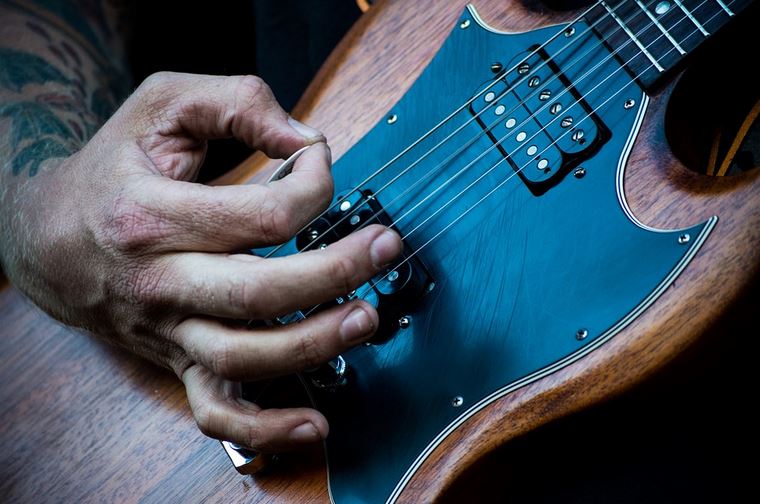
When you’re ready to start playing your electric guitar you need to learn how to use a plectrum. A plectrum is a flat tool electric guitarists use to strum the guitar. One important strumming technique you need to learn is palm muting. Despite it’s name the muting sound is executed by the side of the hand instead of the palm.

Whenever you strum the guitar you need to make sure you’re fingers are a little more relaxed than if you were playing power chords. When you’re playing power chords try to pull the plectrum inside so the tip of your index finger comes in contact with the string first, and then followed by the plectrum.

You can tell how much harmonic content you want to get out the chord by just changing up the angle of your picking hand a little. Once you practice and get more comfortable using a plectrum it’s time to learn some easy chords to begin with. Some of the easiest chords are as follows: A major, C major, D major, E major, G major, A minor, D minor, E minor, A 7th, B 7th, C 7th, D 7th, E 7th and G 7th. Take your fingers and place them behind the fret you’re supposed to play.

Every time you play a note you want to make sure it sounds good. Some guitarists find it helpful to keep their fingers perpendicular to the fretboard when playing chords. Many beginner guitarists are taught that their thumb should always be placed in the back of the neck in the middle.

However, if you notice that your thumb ends up in an awkward position when you’re playing a certain chord you can change up the position of your thumb until it best fits you. That’s  it for this beginner electric guitar lesson. If you want to get better at the electric guitar you have to keep practicing your open chords  and then move on to barre chords, power chords, and  guitar scales.